Negative Space. A Recruitment AiDE, pt 16

Greg Wyatt • February 19, 2026

I find myself questioning whether I effectively use AiDE, and whether it's effective enough every time I recruit.


As an external partner I work low volume, which allows time to do things 'right'.


However, when I take on fractional in-house work, I still deploy the same framework, even at mid volume (my highest volume was 55 vacancies in six months). Because it's scalable and can be applied across a whole recruitment system.


I wouldn't recommend it to a high volume, high churn environment, though I expect they aren't reading these newsletters.


It isn't just about advertising.


A current vacancy is at final interview today. I ran an 'appropriate multichannel' campaign, including public advertising, networking & referrals, 'headhunting' (sourcing across LinkedIn and CV databases).


My advert was a consequence of my consultations, as was the six page candidate pack provided to viable applicants.


My narrow then wide sourcing strategy was a consequence of the same consultation.


My written and spoken outreach was also a consequence of this. That I shared the advert and candidate pack proactively, was in part why I had a 100% response rate to my six inmails (it's a niche role in a low population area).


What was also interesting was that a number of the applicants described themselves as passive, and there was a significant overlap between the 56 and the sourced longlist. I noted that one of the final interview sourced candidates had viewed the public advert after our initial conversations.


I find advertising can be effective with passive candidates, because they can browse without commitment. You'll never know they were there if they don't get in touch, and they aren't going to be interested in a cookie cutter peacock advert.


But that gap is a hard one to breach if all you know is "we're a market leading employer of choice". Because we rely on the evidence of what's in front of us.


This is the final AiDE piece. I plan to publish this as a short paperback, given I think it stands alone as an approach that can improve your recruitment.


Next week I start "Innovation from Iteration" which includes an article on why the Gemba (value from the shop floor) is valuable for recruitment. Where it relates here is that my work with job seekers, and what turns them off from enquiring to adverts, has been so helpful in finding the blind spots our habits miss.


While the next series is separate, and was mainly written before AiDE, both show the modularity of recruitment and how you can experiment iteratively, layering on good foundations in a way that best works for you.


As I've said before, you can see pretty much all of me through these pieces, which may help you decide whether we should ever do business together.


This final piece is about how negative descriptors can attract great people. In the example above, one of the lines I lead with is "this won't be for you if you thrive in a structured, corporate environment." Both because it's true, and because it speaks to frustrations viable candidates may have.


Of course I also talk about how they can make a bigger splash in a smaller pond, if they can adapt to a smaller company setting.

Pushing and pulling are key tools in the AiDE framework.


Negative Space


June 2023


“This isn’t just any typical food manufacturing company, with an as-is workforce that only requires handholding and firefighting.”


A bit of context: HR in the East of England is fragmented, with many senior HR practitioners being more of the old-school personnel approach than commercially focused. And others adopt the People title with no rhyme or reason.


A common reason for commercial HR vacancies rejecting candidates who have identical CVs to successful candidates is that line above.


It resonates with many commercial HR practitioners that have interviewed either as an employer or candidate.


Firefighting here means the high volume of employee relations common to food manufacturing. No time to do the proactive stuff.


I should point out this was a confidentially advertised vacancy.


Were it branded or directly advertised, you’d need to think about how this kind of description is perceived, in case you’re seen to criticise your ‘competitors’.


When I ran it on LinkedIn, there were 32 applicants, 14 of whom were auto-rejected by the killer question ‘do you have full right to work in the UK’.


10 were suitable enough to call.


2 of these were submitted to the employer, alongside 3 found through other means. 1 of them got the job.


In total, I spoke to around 40 candidates before presenting this shortlist.


“That line really struck a chord with me, and it’s so true of some of the companies I interviewed with last time”, said the candidate that went on to get the job. She'd also seen their original advert and not applied, because it seemed exactly the same as her current one.


She wasn’t the only person to comment so.


Disappointingly, not one person spotted the M&S allusion.


By highlighting what it isn’t, this line draws attention to what it is:


The negative space of a vacancy.


It’s actually pretty simple to find this kind of example for any common skill vacancy - I include a niche HR role in this category.


“What reasons have you had for declining candidates, in terms of skill sets, context or attitudes?”


“Why wouldn’t someone work out in this role?”


“Why did it go wrong last time?”


The answer’s with the hiring manager.


If it’s a role for which there are archetypes for success and failure, you can set the scene while speaking to the ikigai and experiences of your readers.


We should be mindful of bias of course:


“This isn’t a company with a diverse workforce or where people stay longer than a year” might be an accurate counterpoint to concerns about culture fit and institutionalisation, but perhaps not something you want to advertise.


“You’ll hate it here if you’re a West Ham fan.”


“If you enjoy the machinations of structured corporate life, this won’t be for you.”


It’s an approach that works for many reasons:


  • It sets the scene with texture and candour
  • It appeals to the experiences of candidates and builds trust
  • It tells them they aren’t going to waste their time by going for the wrong job
  • It shows you know the truth of the vacancy, from unexpected angles
  • For readers that enjoy “a steady reactive workload where they can support line managers through disciplinaries and grievances,” they’ll get a sense they aren’t an ideal candidate, confirmed by the rest of the advert. Nothing wrong with what they do, of course, it’s just a different type of HR.
  • It’s an ‘essential requirement’ in disguise that helps readers make the right decision while giving an implicit and constructive reason for saying no
  • It’s unusual enough to be a pattern interrupt that encourages credibility and to focus on the rest of the advert


If relevant, I’ll include ‘negative space’ in my adverts, whether above-the-line or below-the-line.


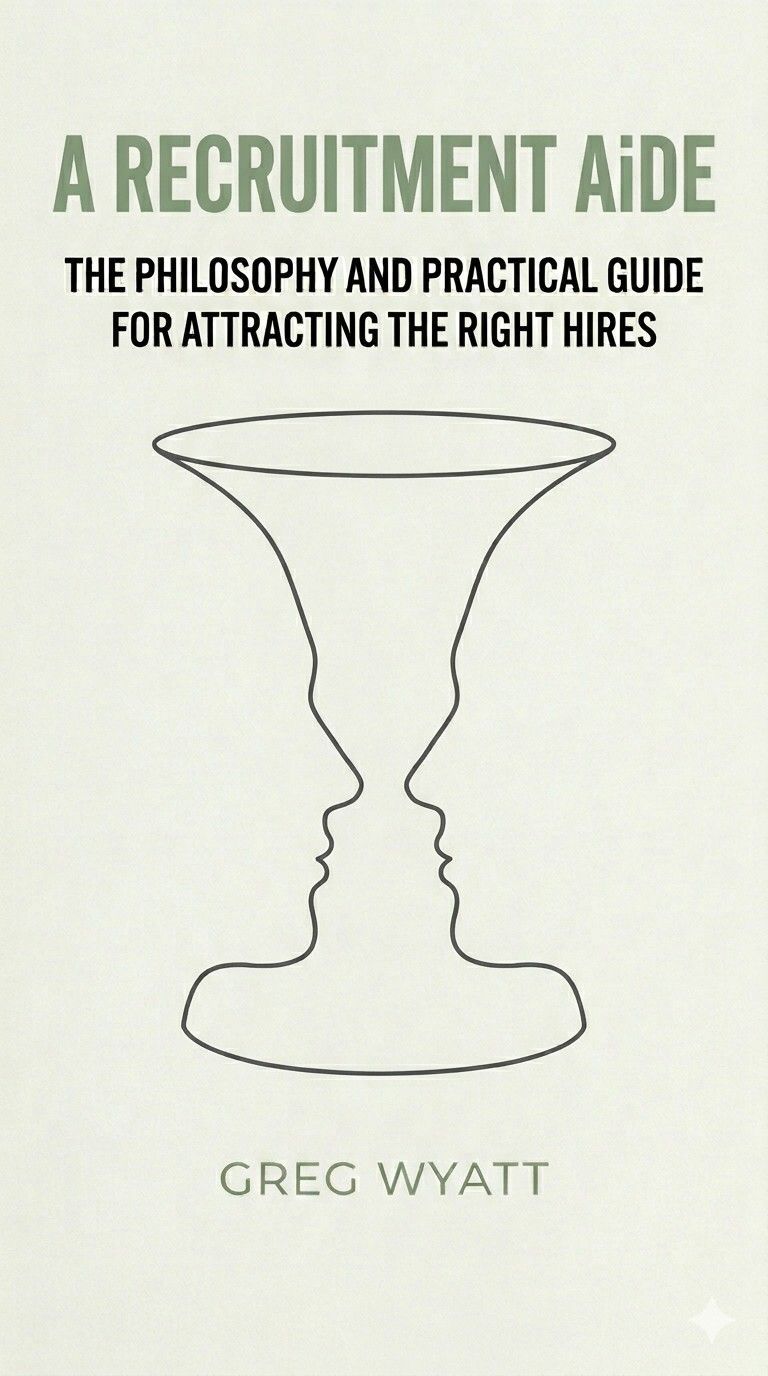
If you were wondering about the picture, which is a style you are likely familiar with – it’s Rubin’s Vase, an optical illusion whereby two faces are created from the negative space of the vase.


Thanks for reading.


Regards,

Greg


By Greg Wyatt March 30, 2026
What follows is Chapter 39 of A Career Breakdown Kit (2026) . It's 10 months old, so surely the algorithm has moved on right? Indeed, my own content performance has tanked if you compare 2026 to 2025. Around 12 million views of my content last year, while if I extrapolate my year to date performance, it looks like a little shy of 640,000 views. My LinkedIn feed is quieter, yet real life relevant conversations go from strength to strength, many of which stem from my content. Look, I don't love the term, but I am a fan of putting your message out there, across multiple means, so that your most relevant audience might become aware of you. And perhaps your relevant audience is an audience of one, a person who can put you nearer that job. Which is the only algorithm you need. This is a three part series, with part 2 on " Content strategy and philosophy " and part 3 on " A flair post ". Click on the links for the unedited versions on Substack. 39 - Introduction to personal branding Whatever you think of LinkedIn, you shouldn’t overlook its nature as a free marketing platform, where you can build a reputation through the words of your posts, comments and messages. Personal branding is a viable tactic as part of a multi-channel approach to your job search and it can bring opportunities to you. I'll start off by saying I'm not a fan of the term personal branding. It can lead to make-work which can even get in the way of what you should be doing. Writing and using content to create experiences that support a job search is a great idea and calling it personal branding - as a discrete activity - isn’t a bad thing. I expect there are many mediums through which you can build a personal brand. I'll focus on LinkedIn because of how entrenched it is in other job search activities. What a personal brand is For businesspeople the idea is that by building awareness of your personality, lifestyle and what you're promoting, you also build trust. So that when people are ready to buy, they'll buy your products. The brand might be personal. The goal is sales. When you see personal branding on LinkedIn it’s often a business that promotes their services through the account of the author. ‘Here’s my puppy, buy my stuff.’ Take note that the target audience for these advice posts is the businesspeople above. And these posts often seek to part them from their money. Your goals are similar. If there’s a commercial outcome you want, it’s likely a single job, not a throughput of leads. You’ll also see that controversial content gets huge engagement and can also repel readers. If you need a job, what’s the danger of writing overly spicy content? Could a reader make a decision against you based on your words? How much you need any job should inform the experience you want to create for your readers. How it sits in your wider job search Publishing content is about raising awareness and starting conversations with the right people. This can be your profile, written posts, newsletters, (bestselling) career breakdown kits, videos, you name it - anything you can become known for. In many ways the hierarchy of relationships your content appeals to is the same as with networking. Content can be publishing posts, commenting on the posts of others, sending direct messages. I’d argue even your applications and interviews are part of your personal brand. I think of LinkedIn posts like a plumber’s van driving around town. Most of the time you’ll disregard the van unless it cuts you up with noxious fumes. When you have a leaky pipe, you’ll surely take note of their number. It can support an application if a hiring manager decides to surreptitiously stalk your profile. And it can work against you if it suggests problem behaviour. A good balance for content is the poster in my daughters’ primary school from a few years back: THINK. Is it True? Is it Helpful? Is it Inspiring? Is it Necessary? Is it Kind? Achieve those five points and content will rarely work against your job search. Content should be consistent with your wider activity. Which means that everything people (potential employers) experience of you is a complementary and non-contradictory message. Content that contradicts your CV or cover letter may lead to red flags, whether that’s fair or not. Content should be intentional. HOW TO GO viral, and why you shouldn’t Anyone who writes content will enjoy the sweet, sweet flow of dopamine when you see reactions and comments trickle in. Such as that first flair post announcing you are available to help your next employer with examples of your achievements and what you are looking for. Do that and you’ll get loads of engagement. Why haven’t you done it yet? Tag me in and I’ll support you. Or you can do what most people do and say, ‘I’m sorry to announce I’ve lost my job, please help’ and that will get loads too. Because it is relevant and relatable to fellow job seekers, recruiters and sympathisers. Then you feel the soul-crushing defeat of a well-thought-out post, highlighting a problem in your industry, with tumbleweed to follow. Both types of content have a place. That tumbleweed post is relevant and relatable to a niche audience. I try to take a land and expand approach to content - job seeker advice, recruitment advice and stories, ponderings and satire, which I use to tackle topics from different directions. Over the past three years I’ve had between 3m to 11m views of my posts and I’ve gained a bit of business through them too. What I don’t do is try to go viral anymore. Because when I have gone viral with a few 1m impression posts, it’s taken weeks to extricate myself from them and there hasn’t been real benefit. I find my tumbleweed posts start better conversations from lurkers - those that never engage publicly. I promised you I’d show you how to go viral. Here you go. Relevance + relatability + readability + entitlement. Maybe add a selfie. If that seems too simple, search for this sentence on LinkedIn: “An employee asked me if he can WORK from HOME permanently.” You’ll need to use the double speech mark to search on the phrase, and rank by Posts. ‘Does it really work?’ asked Charles. I told him to try it as an experiment. He rarely got more than a few hundred impressions per post. 170,000 impressions, 2,000 reactions. Pretty viral for a first timer. It is the wrong path. What do these posts actually say? Who are they aimed at? And if they don’t appeal to people who can help you reach your objective, what’s the point? 
By Greg Wyatt March 26, 2026
I was tempted to use another Tom Cruise AI image for this article, but his hands ended up looking like feet, which wasn't a true representation of him. Probably not fair to use AI in this way either, stealing copyrighted material without permission. And so I use this AI 'stock image' instead, which is probably also highly unethical, but feels more suitable and sufficient . Anyway here's an article about why the same principles are crucial for good recruitment: ‘True and Fair’ is an accountancy concept that lies at the heart of reporting, and can be applied effectively in recruitment. Its meaning is that any financial statement made about a company should accurately and completely represent its financial position and performance. The role of auditing is to confirm that documentation meets this definition. Do so and everyone knows what they are dealing with. HMRC, shareholders, customers, suppliers, employees – useful, and in many cases necessary, to have access to a true and fair view of a company’s accounts. Can something be true and not fair? In 2001, Enron went bust, a huge scandal with real-life repercussions that led to new legislation in the US. Their accounts were true, in that they conformed with the required laws and standards. However they had an incredibly complex reporting structure which made it impossible to see the overwhelming debt they had. Poof! Bye-bye a $100bn company when this all came out in the wash. How about fair but not true? This can happen if a situation is described which gives a fair picture but lacks accuracy. An example here could be the UK politician who HMRC deemed behaved fairly but made errors in his tax reporting. Only a few million quid plus penalty. What types of recruitment documentation does this apply to? Three key ones that spring to mind (although there’s no reason it can’t be applied everywhere): The job description. The job advertisement. The CV. If these three documents were always a true and fair representation of either a job or a candidate, you’d interview and hire better candidates who stick around longer. With the caveat that these documents should also be ‘suitable and sufficient’, if you remember last week's edition. Documents are the first step in a recruitment process, relating to a decision to apply and the decision to interview. Is it not the case, that the second most common complaint in recruitment is “not what we expected”? Therefore, if we nipped this complaint in the bud, with true and fair documentation, wouldn’t life be better for everyone in the recruitment process? What does true and fair mean in recruitment documentation? I think it has to cover three points. 1/ factually correct 2/ shows context suitably 3/ describes sufficiently An immediate objection might be that job descriptions are always true and fair, but I’d argue this is actually rarely the case. If you recruit for a new role, do you audit your job description against the current context? If you have a generic job family description does it show the specific day-to-day duties of a role? Have things changed in the current role that makes it different to the last time you recruited? A common scenario in recruitment is that Greg resigns, and the hiring manager says “we’d love someone just like Greg”. Yet if Greg resigned, wouldn’t someone just like Greg be at risk of resigning for the same reasons in future? Would now-Greg have applied for the same role that then-Greg applied for? Which definition of Greg is the true and fair one you’d hire? It feels strange writing my name like this. There are lots of different situations in which a job description that was true and fair a few years ago is no longer so. The only way to ensure it is true and fair, is to audit documentation prior to going live. You may think a fully representative and accurate contextual analysis is too time-consuming for most vacancies, especially where it doesn’t actually matter if there is some inaccuracy. “Oh yeah, that’s not relevant anymore”. But if you have a key hire that can make a difference in your business, ‘true and fair’ should be the starting point, each and every time. If you have a systematic process that finds truth and fairness, you’ll see the benefit of applying the same across any vacancy – for the reason that the time invested at the outset is offset by interviewing fewer unsuitable candidates and wasting less time and resources overall. And what should be the more important reason of better recruitment outcomes. For any project I take on, this is the first step – getting the documentation in order. Get it right and everything flows from there. It’s a key reason behind my nearly 100% fill rate. It’s also one of the reasons my average tenure is over 4 years for key hires. These achievements don’t come down to chance. They come from my process. If you've forgotten why suitability and sufficiency is the other pillar, here's an example that isn't suitable: Nineteen experiential bullet points might be true and fair but will also encourage ideal candidates to run away screaming. See you next time. Regards, Greg p.s. While you are here, if you like the idea of improving how you recruit, lack capacity or need better candidates, and are curious how I can help, these are my services: - commercial, operational and technical leadership recruitment (available for no more than two vacancies) - manage part or all of your recruitment on an individually designed basis for one client. This can be a large as end-to-end delivery of a programme of vacancies, or as small as writing one job advert for a key hire- recruitment strategy setting - outplacement support